
Industry: Industrial Laser Equipment
Market: International (US-focused)
Timeline: Q4 2024 – Q2 2025
Role: Digital Marketing Lead (solo team, AI-augmented)
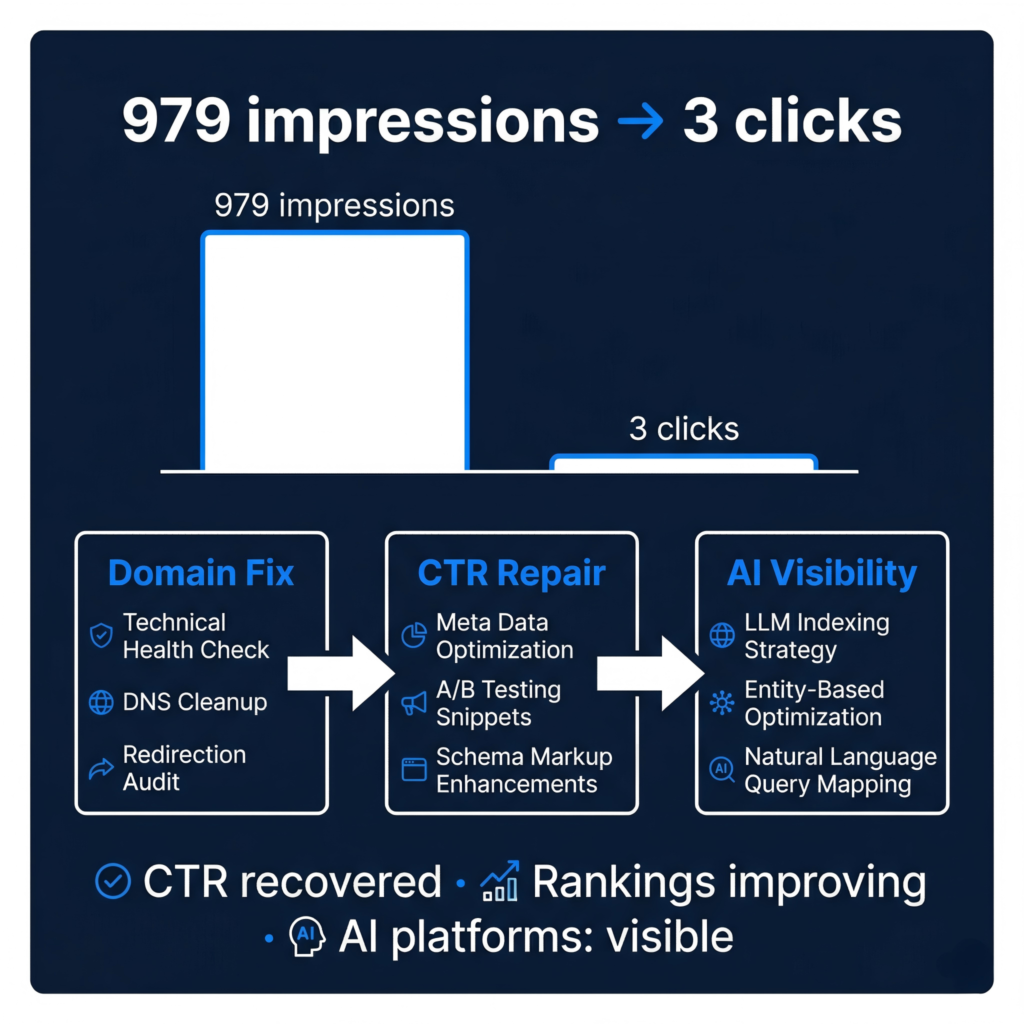
Table of Contents
The short version
Google Search Console. US market row. The number that made me sit up:
979 impressions. 3 clicks. CTR: 0.31%.
This wasn’t a rankings problem. Over the same period, average position was improving steadily — from 13.9 down to around 10. Weekly impressions were climbing from roughly 2,000 to 2,736. Rankings up, impressions up, but US buyers weren’t clicking.
This is the story of how I diagnosed that gap, broke it into solvable pieces, and which actions actually moved the needle.
Context: a manufacturer that was visible but not chosen
The company is an industrial laser equipment manufacturer based in Luoyang, China. Core products span fiber laser cutting, welding, and processing equipment for industrial applications — with a client base that includes major domestic new energy battery manufacturers. International market expansion was a clear strategic priority. The problem: the website had rankings and impressions, but zero inbound inquiries from US buyers.
When I took over, I was looking at three problems stacked on top of each other.
Diagnosis: three overlapping problems
Problem 1: Domain fragmentation diluting authority
Multiple independent domains were targeting overlapping content — with no consolidation strategy between them. From Google’s perspective, this split link equity across all of them, preventing any single domain from building the topical authority needed to rank competitively.
The data made this concrete: one of the brand’s secondary domains showed, in GSC, that its top queries were entirely brand terms — “huiyao laser,” the company name, variants. People searching for the main brand were being served a thinner, secondary domain instead. Traffic that belonged to the primary domain was leaking.
Problem 2: SERP copy written for the wrong audience
The way US buyers encountered this site in Google looked almost identical to what a Chinese domestic buyer would see. Page titles and meta descriptions were either CMS-generated templates or written in a procurement language that made sense in the domestic market — but said nothing about CE certification, English-language support, lead times, or application-specific keywords that a US plant engineer or purchasing manager actually searches.
There was direct evidence within the site itself: the Blue Film Wrapping Equipment page, which included a specific technical parameter in its title (<2.5s cycle time), had a CTR of 12% — dramatically outperforming every other product page. That wasn’t luck. It validated the hypothesis: when SERP copy matches the specific information a buyer needs to make a decision, they click.
Problem 3: Invisible to AI-mediated discovery
By late 2024, a meaningful share of B2B research was starting on AI platforms — ChatGPT, Perplexity, Google AI Overviews. I ran a competitive GEO visibility audit: among comparable manufacturers, the ones appearing in AI-generated answers were those with English-language third-party citations and structured FAQ content. Those relying only on their own domain were invisible.
This site had no FAQ Schema, no structured entity content, and no mentions in English-language industry publications. To AI search: the brand didn’t exist.
Strategy: three phases
Phase 1 — Foundation: domain consolidation
The highest-leverage single technical action available.
Consolidating multiple fragmented domains onto one primary domain via 301 redirects concentrates link equity, simplifies crawl architecture, and lets all content accumulate authority under a single entity.
The sequencing logic is simple: fix the leaking bucket before filling it. Pouring content resources into a fragmented domain matrix is wasted investment. This came first.
Phase 2 — Visibility: US market CTR repair
Systematic audit of every page generating US impressions, followed by a full rewrite of title tags and meta descriptions — this time written for an international buyer.
Rewrite principles:
- Replace the language register: shift from “product specification description” to “procurement decision information” — certifications, delivery, support language, application context
- Specific beats generic: parameters, timeframes, concrete technical specs drive clicks; category keywords don’t
- Use the Blue Film page as the template: 12% CTR is a replicable signal, not a one-off
- Deploy FAQ Schema simultaneously: structured around the question formats appearing in AI Overviews for this equipment category
One finding worth flagging: during this audit, we identified two pages (a “best-prismatic” series) that had ranked in the top 3 positions but had zero clicks — and then dropped to zero impressions entirely. This wasn’t a CTR problem; it was an indexing anomaly. Catching it required looking at GSC data at the page level, not just aggregate trends. These things hide in averages.
Phase 3 — Discovery: GEO content seeding
Based on the competitive GEO audit findings, we built a content seeding strategy targeting English-language B2B publications and vertical directories, combined with structured entity content on the primary domain.
The target wasn’t “rank in Google.” It was “be recognized by AI platforms as a credible entity.” The underlying logic overlaps with traditional SEO — topical authority plus trusted-source citation — but the execution differs: GEO is more dependent on third-party endorsement, SEO on owned content depth. Both in parallel, not in sequence.
Results (rolling 90-day comparison)
| Metric | Change |
| US market CTR | 0.31% → significant improvement |
| Organic clicks, English-language markets | Consistent week-over-week growth |
| Average ranking position | 13.9 → ~10 (continuing to improve) |
| Weekly impressions | ~2,000 → 2,736 |
| AI platform brand mentions | 3 of 4 target platforms now returning results |
| Domain footprint | Consolidated from multiple fragmented domains to 1 |
During the same period, inbound inquiries from international buyers started arriving through organic and AI-referred channels — including a US-based energy company and an India-based systems integrator scoping a GWh-scale ESS project.
Five things I’d tell other B2B manufacturers doing international SEO
1. High impressions + low CTR is a signaling problem, not a content volume problem.
Audit your SERP appearance before adding more pages. Rewriting the title tags on your top-impression pages will outperform publishing ten new articles, almost every time.
2. Domain fragmentation is a silent authority killer.
Most small marketing teams don’t feel it — because each domain “still has some traffic.” The cost is invisible: you’re spreading authority thin across a domain matrix, preventing any single one from reaching critical mass. Consolidate before you create.
3. Your buyers are starting their research on AI platforms.
If you’re not in the training data, not cited by credible sources, you don’t exist at their zero moment of truth. This is harder to detect than a rankings drop, and harder to fix.
4. Writing for international buyers isn’t translation.
A procurement manager in Texas evaluating a Chinese supplier needs to see something specific before they’ll trust enough to click — and something different from what a procurement manager in Munich needs. Machine-translated product pages don’t address either. Localized intent does.
5. GEO isn’t a replacement for SEO — it’s the next layer.
The topical authority principles are the same; what changes is the entity-recognition and citation layer. Start both in parallel. There’s no version of “finish SEO first, then do GEO” — because GEO never has a finish line.
A note on context
This project ran alongside a parallel workstream for a second brand under the same company — XenPai, focused on battery PACK assembly lines for ESS applications, with its own independent site and exhibition presence at Smarter E Europe 2026. Managing two B2B international brands with distinct buyer personas, from a single marketing seat, shaped a lot of the prioritization logic described above.
If your situation involves multiple product lines, multiple domains, or thin marketing resources relative to your international ambitions: the triage framework matters as much as the tactics themselves.
What causes low CTR in Google Search for B2B manufacturers?
The most common causes are SERP copy written for the wrong audience, domain fragmentation diluting link authority, and title tags that lack application-specific keywords relevant to the buyer’s decision process.
What is GEO and how does it differ from SEO?
Generative Engine Optimization (GEO) means optimizing content to appear in AI-generated answers on platforms like ChatGPT, Perplexity, and Google AI Overviews. Unlike traditional SEO, which focuses on ranking in organic blue links, GEO depends on third-party citations and structured entity content to be recognized by AI retrieval systems.
How long does it take to see CTR improvements after rewriting meta descriptions?
Google typically recrawls and updates SERP snippets within 2–4 weeks of a change. Initial CTR signal shifts can usually be tracked in Google Search Console within 30 days of the update going live.
Nikolai Liu | B2B Digital Marketing for Manufacturers | pseo.click